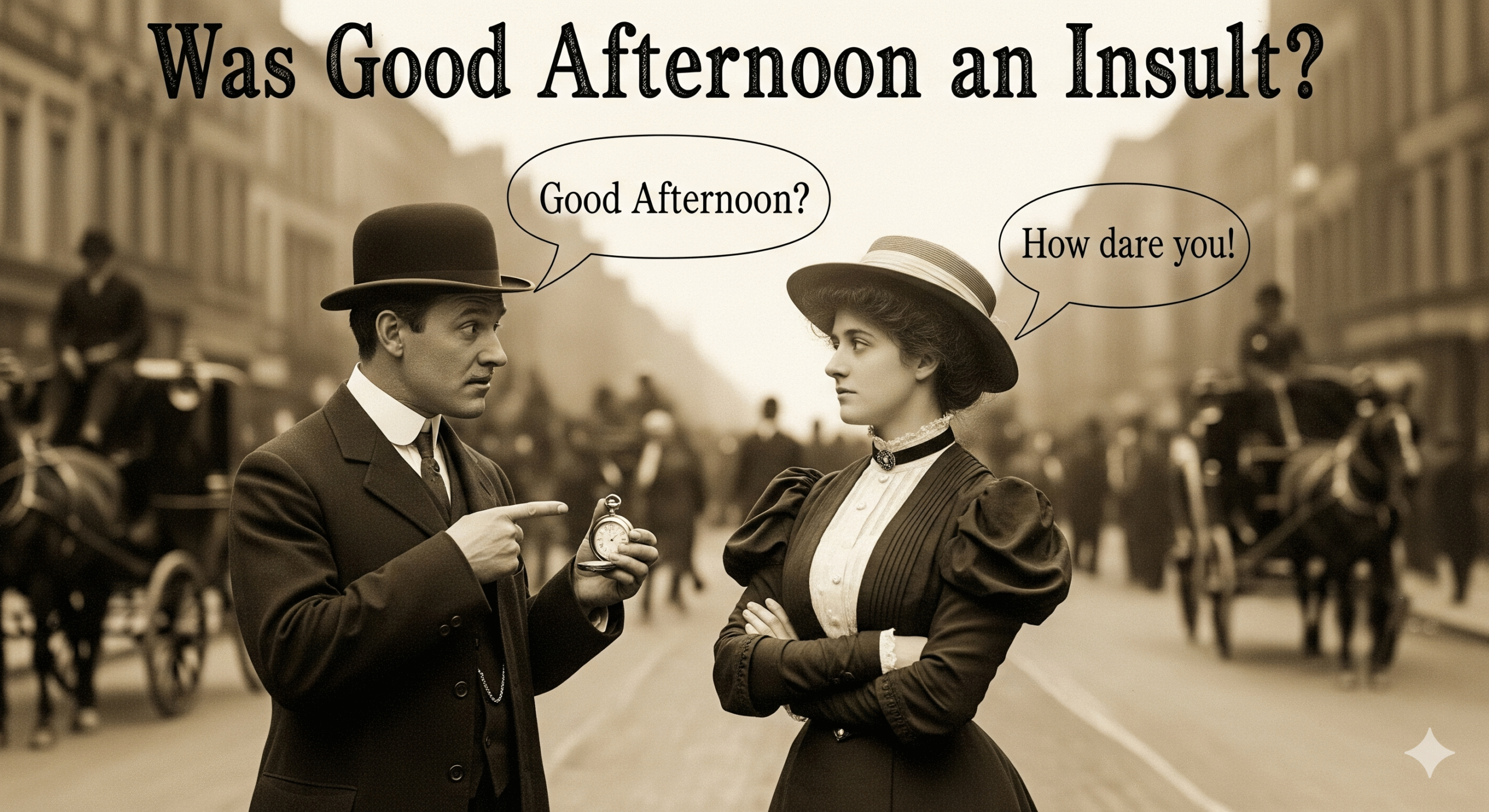
No, “good afternoon” was never an insult in itself. It has always been a polite, time-of-day greeting in English. It can, however, be used as an insult through tone and timing: said sarcastically to someone who arrives late, wakes up late, or as a curt way of ending an argument, the same polite words become a pointed jab.
That gap between the words and the way they are delivered is why the question keeps coming up. Below we look at where the greeting comes from, the specific situations where it sounds rude, how other cultures handle afternoon greetings, and how to use it so it always lands as courteous.
Quick Answer: When Good Afternoon Is Polite and When It Isn’t
| Situation | How it usually lands | Example |
|---|---|---|
| Greeting a colleague, client or teacher after midday | Polite and professional | “Good afternoon, Professor.” |
| Opening a formal email, call or presentation | Courteous and neutral | “Good afternoon, everyone, thanks for joining.” |
| Between close friends | Overly formal, sometimes playful | Said with a grin as a mock-formal hello |
| To someone who arrives late in the morning | Sarcastic, a jab about lateness | “Good afternoon!” to a coworker walking in at 10 a.m. |
| To someone who just woke up | Teasing about sleeping in | A parent greeting a teenager at 11 a.m. |
| Abruptly ending an argument | Dismissive brush-off | “Well then. Good afternoon.” |
| Late in the evening | Awkward or out of place | Using it at 7 p.m. instead of “good evening” |
Where the Greeting “Good Afternoon” Comes From
The Word Afternoon
“Afternoon” is a simple compound of “after” and “noon,” and it appears in English from the Middle English period. The word “noon” itself has an interesting history: it comes from the Latin nona hora, the “ninth hour” counted from sunrise, which originally fell in mid-afternoon. Over time, “noon” shifted to mean midday, and “afternoon” came to mean the stretch of the day between midday and evening.
Time-of-Day Greetings in English
English has long used “good” plus a time of day as a well-wishing formula. Older forms like “good morrow” and “good day” were common for centuries, and they gradually gave way to the set we use now: good morning, good afternoon and good evening, with “good night” mostly reserved for saying goodbye. At heart, every one of these is a shortened wish: “I hope you have a good afternoon.” There is nothing negative built into the phrase.

Etiquette and Formality
In the 19th and 20th centuries, formal greetings were closely tied to manners, social standing and workplace culture. “Good afternoon” became the standard choice for shops, offices, schools and official correspondence, which is why it still sounds a little formal today. That formality is exactly what makes it useful for sarcasm: the more correct a greeting sounds, the sharper it feels when it is clearly not meant warmly.
Why “Good Afternoon” Can Sound Like an Insult
The words stay polite. What changes is the message underneath. These are the most common ways the greeting turns into a dig.
1. The Late-Arrival Jab
This is the classic use. A manager, teacher or parent says “Good afternoon!” to someone who turns up late in the morning. The literal meaning is wrong on purpose, and the joke is clear: you are so late it might as well be the afternoon. Depending on the relationship and tone, it can be gentle teasing or a pointed public rebuke.
2. The Sleeping-In Tease
Similar logic applies to anyone who gets up late. Greeting a roommate or teenager with “good afternoon” at 11 a.m. is usually affectionate ribbing, but it can sting if it is part of a pattern of criticism.
3. The Conversation Ender
Said abruptly at the end of a disagreement, “Good afternoon” works as a polite slammed door. It signals “this conversation is over” without using any rude words. This mirrors the well-known “I said good day, sir!” line from the 1971 film Willy Wonka & the Chocolate Factory, where a formal farewell is used as a furious dismissal.

4. Cold or Clipped Delivery
A flat, clipped “good afternoon” with no eye contact or smile can feel colder than saying nothing. In customer service and workplace settings, people often read it as passive-aggressive, especially when the person normally greets them warmly.
5. Excessive Formality Between Friends
Because most people say “hi” or “hey” in casual conversation, an unexpectedly formal “good afternoon” in a group chat or text can read as distant or annoyed. It is often meant as a joke, but without tone of voice the message can be misread.
Polite Words Used as Weapons: A Familiar Pattern
“Good afternoon” is far from the only courteous phrase that can carry an edge. English is full of polite formulas that people use to express irritation while staying technically civil:
- “Good day, sir”: a formal farewell often used to end an argument.
- “With all due respect”: commonly signals disagreement or even disrespect.
- “Per my last email”: a workplace phrase widely read as “you did not read what I sent.”
- “Bless your heart”: in parts of the American South, it can express sympathy or gentle condescension depending on context.
- “Thanks in advance”: sometimes received as pressure to comply.
The pattern is the same each time. The phrase is polite on paper, and the speaker relies on context and tone to communicate something else. That is why linguists talk about pragmatics, the study of meaning in context, rather than just dictionary definitions.

How Other Cultures Handle Afternoon Greetings
Not every language divides the day the same way, which affects how an afternoon greeting is received.
| Language | Afternoon greeting | Notes |
|---|---|---|
| Spanish | Buenas tardes | Very common and warm; covers afternoon and early evening |
| French | Bonjour / bon après-midi | Bonjour is used all day; bon après-midi is usually a parting wish |
| German | Guten Tag | A general daytime greeting rather than a strictly afternoon one |
| Italian | Buon pomeriggio | Used, though buongiorno often covers the earlier part of the afternoon |
| Japanese | Konnichiwa | A general daytime greeting; politeness also depends on bowing and register |
| Arabic | As-salamu alaykum | A greeting of peace used at any time of day |
In many languages the everyday greeting is not tied to the clock at all, so a time-specific phrase can feel more formal than intended. And in every culture, delivery matters: a curt, unsmiling greeting can seem cold no matter which words are used.

Good Afternoon Online and in Pop Culture
Online, “good afternoon” often shows up as a deliberately stiff joke. People use it in replies to sound mock-formal, in memes that exaggerate polite workplace speech, and in skits parodying customer service greetings delivered in a flat voice. Because written text strips out tone, the same reply can look friendly to one reader and passive-aggressive to another, which fuels debates about whether the phrase is rude.
Good Afternoon in Professional Settings
At work, “good afternoon” is still one of the safest greetings you can use. It is standard for receptionists, call centers, hotel staff and retail workers, and it is a natural way to open a meeting, webinar or presentation that starts after midday. In these settings, people expect a degree of formality, so the phrase sounds respectful rather than stiff.
It also works well when you are writing to someone you do not know, such as a new client, a hiring manager or a company’s support team. “Good afternoon” avoids the guesswork of “Dear Sir or Madam” and feels more polished than “Hi.” The one catch is time zones: if your email may be read in the morning, a neutral “Hello” can be the better choice.
Where it can go wrong is in tense situations. If a meeting has become heated, closing with a clipped “Good afternoon, everyone” may be read as frustration. A short thank-you before signing off keeps the tone professional.
How to Say Good Afternoon Without Sounding Rude
If you want the greeting to land as warm rather than sarcastic, run through this quick checklist:
- Check the time. Use it from about midday until early evening, then switch to “good evening.”
- Match the setting. It suits emails, meetings, phone calls, shops and classrooms. With friends, “hi” or “hey” is usually more natural.
- Add warmth. A smile, eye contact or a follow-up like “How’s your day going?” removes any chill.
- Avoid it as a late-arrival comment unless you know the person will take it as friendly teasing.
- In writing, add context. “Good afternoon, hope your week is going well” reads far warmer than “Good afternoon.” on its own line.
- Watch for patterns. If you only use the formal greeting when you are annoyed, people will learn to read it as a warning sign.
Common Mistakes
- Using “good afternoon” at 9 or 10 a.m. as a joke in a formal meeting, where it can embarrass someone in front of others.
- Ending tense emails with a bare “Good afternoon” that reads as a brush-off.
- Replying to a friend’s casual “hey” with a stiff “Good afternoon,” which can seem cold.

FAQs
Was “good afternoon” ever originally an insult?
No. It developed as a polite time-of-day greeting, essentially a short way of wishing someone a pleasant afternoon. It only becomes insulting through sarcastic tone, poor timing or a dismissive context.
Why do people say “good afternoon” to someone who is late?
It is a sarcastic way of pointing out lateness. By pretending it is already the afternoon, the speaker suggests the person arrived far later than they should have.
Is it rude to say “good afternoon” in an email?
No. It is a standard, professional opening for emails sent after midday. To keep it warm, follow it with a friendly line rather than leaving it on its own.
What time should you stop saying “good afternoon”?
Most people switch to “good evening” around 5 or 6 p.m., or once it starts getting dark. Using it much later can sound awkward.
Is “good afternoon” too formal for friends?
Usually, yes. Friends tend to say “hi” or “hey,” so a formal “good afternoon” can come across as joking, distant or annoyed depending on tone.
Does culture affect how “good afternoon” is perceived?
Yes. Some languages use one greeting for the whole day, and many cultures put heavy weight on tone and body language. A curt delivery can seem insincere anywhere.
Final Thoughts: Is Good Afternoon an Insult?
“Good afternoon” is a polite greeting, and in most settings it will be received that way. It turns into an insult only when it is used to mock lateness, tease someone for sleeping in, or close off a conversation coldly. Pay attention to the time, the setting and your tone, and it will always come across as courteous. For more everyday etiquette and culture reads, explore our lifestyle category.