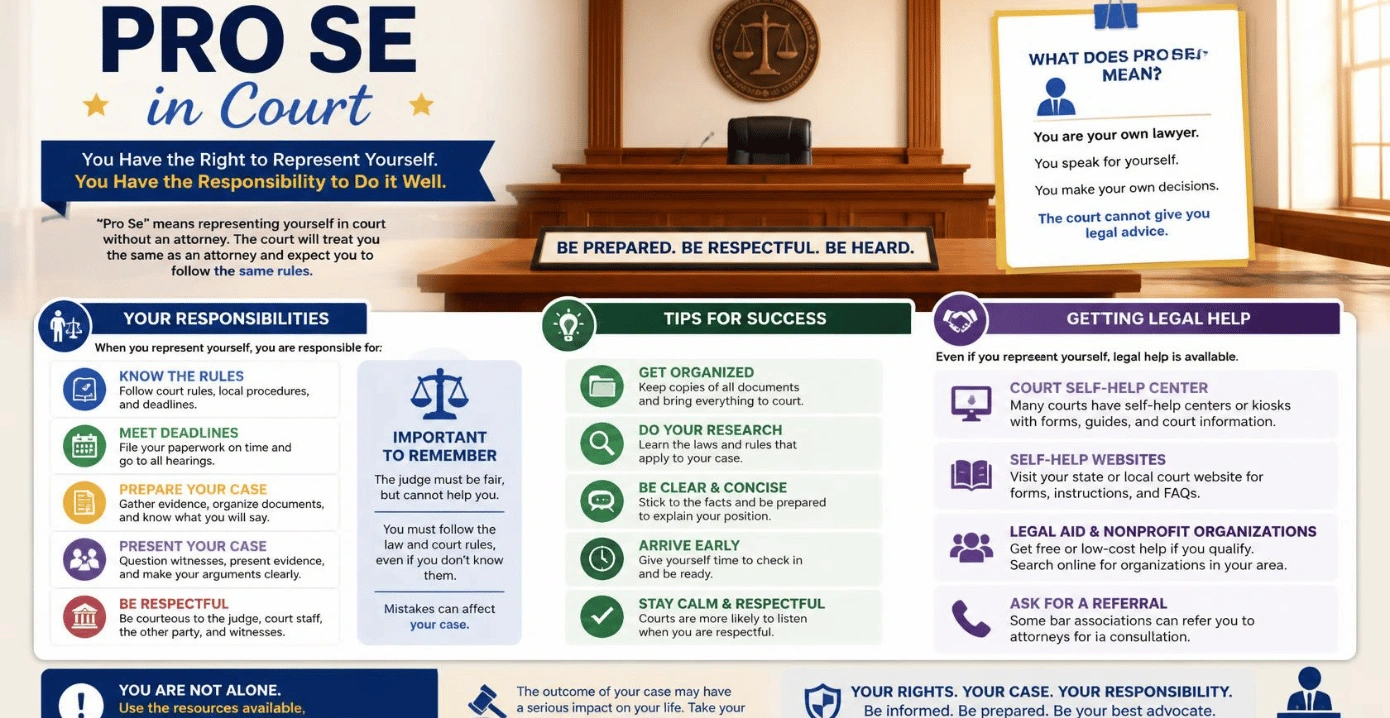
If you represent yourself in a U.S. court case without an attorney, you’re acting on your own behalf. That choice can save legal fees, but it also puts responsibility for court procedures, deadlines, filings, and case preparation in your hands.
Short answer: Pro se means representing yourself in a legal case without an attorney. A self-represented party must still follow applicable procedural rules, filing deadlines, and evidence requirements. Court employees can often explain forms or procedures, but they generally cannot tell you which legal strategy to use.
| Key point | What it means |
| Basic meaning | You appear in a case without an attorney representing you. |
| Pronunciation | Commonly pronounced “proh SAY” |
| Federal right | Federal law permits parties to conduct their own cases personally or through counsel. |
| Court rules | Self-represented parties must still follow applicable procedural and local rules. |
| Legal advice | Court staff generally cannot provide legal advice. |
| Representation limits | You generally cannot act as a lawyer for another person. |
| Business entities | Corporations generally need licensed counsel in federal court. |
| Main risk | Missing a rule, deadline, defense, or evidence requirement can affect your case. |
This article provides general U.S. legal information and is not legal advice. Rules differ by court, case type, and jurisdiction.
What Does Pro Se Mean in Court?
The phrase comes from Latin and means “for oneself” or “on one’s own behalf.” Courts also use terms such as self-represented litigant or unrepresented party. Under federal law, parties may conduct their own cases personally or through counsel, subject to applicable court rules.
Pro se Criminal cases involve additional constitutional protections. The U.S. Supreme Court has recognized a criminal defendant’s right to refuse counsel and conduct a defense when the decision to do so meets the required legal standard. That right does not mean the court becomes the person’s lawyer. It also does not remove filing, evidence, or courtroom requirements.
Can You Represent Yourself in Court?
Individuals can represent themselves in many U.S. court proceedings. Both federal and state courts allow self-representation in various circumstances, although the applicable rules differ by jurisdiction and case type. Whether doing so is practical is a separate question.
A simple dispute involving limited evidence may be easier to manage than a case involving expert testimony, complicated motions, or major financial consequences. Small-claims systems, for example, are often designed to be more accessible to people without attorneys.
You should check the rules of the specific court handling your case. Federal, state, bankruptcy, family, traffic, and appellate courts may follow different procedures.
For a traffic matter, it can also help to compare the risks of self-representation with the potential cost and role of professional counsel. BlogsnBytes covers that issue in its traffic lawyer cost guide.
What Responsibilities Do Self-Represented Litigants Have?
Representing yourself means taking responsibility for tasks that an attorney would normally handle.
You may need to:
- identify the correct court and procedure;
- prepare and file documents in the required format;
- meet filing and response deadlines;
- properly serve documents on other parties;
- research statutes, rules, and relevant cases;
- gather and organize admissible evidence;
- respond to motions filed by the other side; and
- follow courtroom procedures and local rules.
Federal courts repeatedly warn that unrepresented parties remain responsible for following applicable rules. Self-represented litigants are generally expected to comply with filing requirements, procedural rules, and local court procedures.
Can Court Employees Help With Your Case?
Court staff can be an important source of procedural information, but there is a clear boundary between providing information and giving legal advice.
A clerk may be able to tell you where forms are located, how a filing process works, or where to find published rules. Court staff generally cannot choose your legal arguments, interpret an order for you, predict what a judge will do, or recommend a legal strategy.
That distinction matters because a person may receive administrative help while remaining responsible for all legal decisions. Many courts also publish self-help materials. Legal aid organizations and law school clinics may provide additional assistance when full private representation is unavailable.
Can You Represent Someone Else or a Business?
Usually, representing yourself means exactly that: yourself. A self-represented litigant generally may present only their own claims and defenses. They typically cannot represent another person in court unless they are licensed and legally authorized to do so.
Business entities may face stricter rules. Corporations generally must appear in federal court through licensed counsel. That distinction can surprise business owners. Owning or managing a company does not automatically give a nonlawyer the authority to represent the corporation in federal litigation. Always check the rules that apply to the specific entity and court involved.
When Is Hiring a Lawyer Worth Considering?
Self-representation carries greater risk when the consequences are serious, or the legal issues are difficult to reverse.
Consider seeking legal advice when a case involves:
- criminal charges or the possible loss of liberty;
- large financial claims or valuable property;
- complicated evidence or expert witnesses;
- unfamiliar statutes or procedural defenses;
- an appeal or a strict filing deadline;
- several parties or multiple legal claims; or
- consequences affecting employment, licensing, housing, or immigration.
For criminal proceedings, BlogsnBytes’ criminal defense lawyer guide explains how counsel can analyze charges, evidence, motions, and courtroom strategy.
Cases involving technical evidence may also become difficult to manage without professional help. Defective-product claims, for example, can involve expert analysis and evidence preservation. The site’s product liability lawyer guide explains those issues in more detail.
Hiring an attorney for full representation is not always the only option. Depending on local rules and availability, a lawyer may provide a consultation, document review, or other limited assistance.
Using AI for Court Research or Legal Drafting
AI tools can help organize information, explain unfamiliar terminology, or produce a first draft. They should not be treated as substitutes for checking legal authority.
That warning has become especially important as courts encounter filings containing inaccurate or nonexistent quotations, cases, or legal authorities generated by AI tools. Self-represented parties remain responsible for the accuracy and honesty of anything they submit to a court.
If you use an AI tool for legal work:
- verify every cited case independently;
- open and read the authority before citing it;
- confirm that a statute or rule is current;
- check whether the authority applies in your jurisdiction; and
- never assume that a quotation exists simply because software generated it.
AI can assist with research, but the person filing the document remains responsible for everything submitted to the court.
A Practical Check Before Representing Yourself
Before deciding to handle a case alone, ask yourself five questions.
- Do I understand what the other party must prove?
Understanding the dispute is not the same as knowing the legal elements that must be established. - Can I identify every important deadline?
A strong legal argument may not help if a required filing is submitted late. - Do I understand the evidence rules that apply to my documents or witnesses?
Having evidence does not always mean that a court can consider it. - Can I clearly explain the outcome I want and the legal basis for it?
Courts decide legal claims, not merely which version of events sounds more persuasive. - What happens if I lose?
Consider potential costs, penalties, effects on property, and appeal rights before deciding whether to proceed alone.
If several of your answers are uncertain, getting advice from a licensed attorney or qualified legal-aid service may help you avoid preventable mistakes.
Your Next Step
If you are considering representing yourself, begin with the website and local rules of the court handling your case. Write down every deadline, required document, and unanswered legal question.
Pro se: Then decide whether you can manage those responsibilities without professional advice. For more plain-language coverage of attorneys, court issues, and legal rights, browse the BlogsnBytes Law section.
Frequently Asked Questions
Yes. In U.S. legal usage, the phrase commonly describes a person handling their own case without an attorney. Courts may instead use terms such as “self-represented litigant” or “unrepresented party.”
You should not assume that normal court requirements disappear because you do not have an attorney. Self-represented litigants are generally still expected to comply with procedural rules, filing requirements, deadlines, and local court rules.
Generally, no. Court staff can often provide procedural information, but they cannot recommend a legal strategy or interpret the law for your individual case.
Check your court’s self-help resources, local legal-aid programs, bar-association referral services, and law-school clinics. Availability and eligibility vary by location.