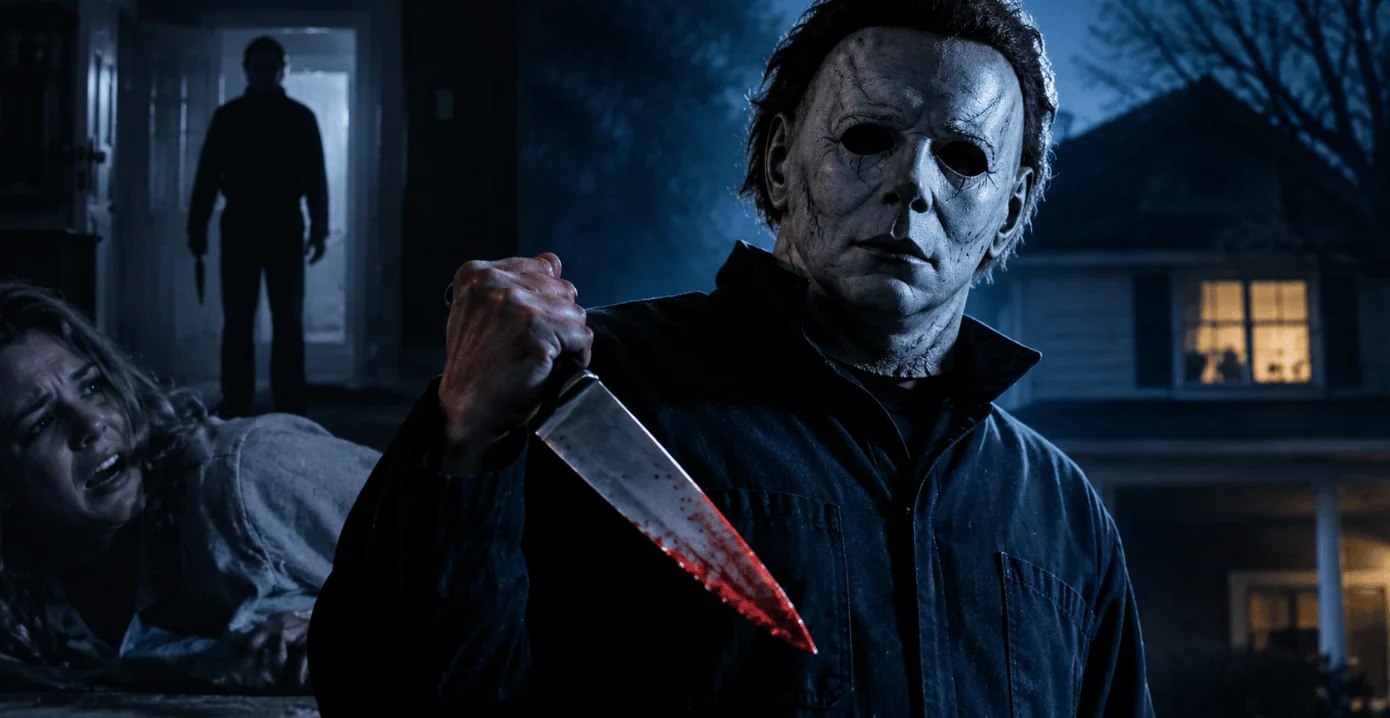
Why does Michael Myers kill? In the original Halloween, there is no clear human motive behind his murders. John Carpenter designed the character as an almost unknowable embodiment of evil, not a killer with a logical grievance. Later sequels, remakes, and alternate timelines added different explanations, including family connections, the Thorn curse, and childhood trauma.
That changing mythology causes much of the confusion around the character. One movie presents him as motiveless evil, while another gives him a specific target. Understanding the answer requires separating the major Halloween timelines instead of treating every movie as one continuous story.
| Question | Short Answer |
|---|---|
| Original 1978 motive | No clear motive is given. |
| Why he targets Laurie | Originally a chance; later timelines make her his sister. |
| Thorn timeline | A supernatural curse drives family killings. |
| Rob Zombie remake | Childhood trauma and psychological disturbance shape him. |
| 2018 timeline | Returns to the original idea of largely motiveless evil |
| Is he supernatural? | The films deliberately leave that question partly ambiguous. |
The Short Answer
Michael kills because the original films treat him as evil without a normal motive. Later continuities change that idea. Some connect his violence to his family, while another introduces the Curse of Thorn. Rob Zombie’s remake gives him a troubled childhood, but the 2018 continuity restores much of the original mystery.
That uncertainty is a major reason the character remains frightening. A villain with an understandable goal can sometimes be predicted. The Shape is scarier because his violence often seems detached from revenge, money, survival, or any other familiar motive.
Why Does Michael Myers Kill in the Original Halloween?
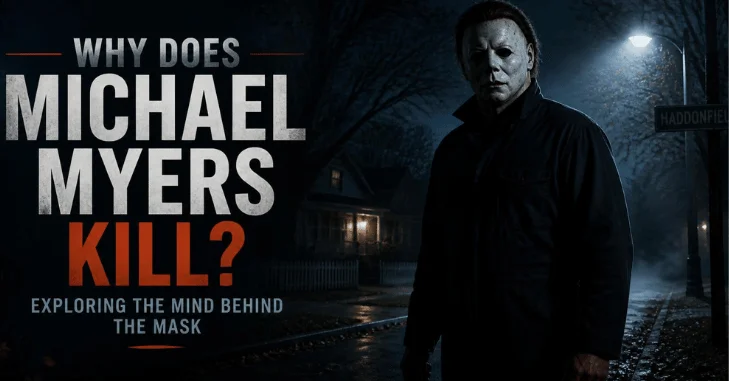
The 1978 film never provides a conventional psychological explanation for his behavior. He murders his sister Judith as a six-year-old, spends years institutionalized, then returns to Haddonfield. The story never reveals a secret grievance that explains those actions.
Carpenter has described the character as a combination of human and supernatural qualities. He wanted the killer to feel like a frightening presence rather than a fully explained person. A Library of Congress essay similarly notes that the character is memorable because the film withholds clear characterization and motivation.
This approach also explains the name used in the original screenplay: The Shape. The mask removes facial emotion, while his silence removes another normal clue to motivation. Viewers can see what he does, but they cannot comfortably explain why he does it.
That lack of explanation is not an unfinished plot point. It is part of the character’s design. Carpenter has said the original story stripped away many traditional horror explanations because they were unnecessary to the fear he wanted to create.
Why Does He Target Laurie Strode?
In the first movie, Laurie Strode is not established as his sister. She becomes noticeable after approaching the Myers house while delivering a key. His later stalking appears to grow from that chance encounter rather than a revealed family connection.
That detail matters because later movies changed the relationship. Halloween II from 1981 reveals that Laurie is his younger sister. The twist provides a clearer reason for his continued pursuit of her and shapes several later sequels.
Carpenter later expressed strong dissatisfaction with the sibling twist. He explained that it was created while expanding the story beyond the original film. The idea became influential, but it was not the motivation established in 1978.
The 2018 film removes that family connection again. That sequel follows the original movie while ignoring the earlier sequel continuity. Universal described the film as a new path from the events of the 1978 classic.
How His Motive Changes Across the Halloween Timelines
The franchise contains several continuities, so there is no single explanation covering every movie. Looking at each version separately makes the mythology easier to follow. It also prevents details from one continuity being mistaken for universal canon.
| Timeline | Main Explanation for the Killings | Laurie Connection |
|---|---|---|
| Halloween (1978) | No clear motive; evil is intentionally unexplained. | No sibling relationship stated |
| Original sequel timeline | Increasing focus on killing family members | Laurie becomes his sister. |
| Thorn continuity | The supernatural curse pushes him toward family murder. | Family mythology remains important |
| H20 continuity | Family pursuit continues from Halloween II | Laurie remains his sister. |
| Rob Zombie remake | Abuse, isolation, trauma, and psychological disturbance | Family relationships remain central. |
| 2018 trilogy | Motivation is again largely unexplained. | Laurie is not his sister. |
The Original Sequel and Family Motive
Once Halloween II made Laurie his sister, family became a stronger explanation for his behavior. Later films continued that pattern through other relatives. Jamie Lloyd, for example, becomes an important target in the fourth and fifth films.
This interpretation makes the killer easier to understand than his 1978 version. His victims may still include unrelated people, but the narrative provides a central target. He repeatedly pursues members of his own family across this continuity.
The tradeoff is that a clear goal removes some mystery. A killer hunting relatives has a recognizable purpose. Carpenter’s original version was disturbing partly because viewers could not reduce his actions to a simple mission.
The Curse of Thorn Explanation
Halloween: The Curse of Michael Myers provides the franchise’s most explicit supernatural explanation. The film connects his violence with the Thorn mythology. That story presents a curse associated with killing family members.
This explanation attempts to answer two recurring questions at once. It offers a reason for his obsession with relatives and gives the story a supernatural framework. Earlier films had kept both issues much less defined.
Fans remain divided over that choice because explanation changes the character. Mystery allows viewers to imagine something unknowable behind the mask. A specific curse creates rules, history, and a cause that can be discussed more directly.
Rob Zombie’s Halloween Gives Him a Backstory
Rob Zombie’s 2007 remake takes a different approach by spending much more time on childhood. In this version, Michael grows up in a troubled household and experiences bullying, abuse, anger, and increasingly violent behavior. The movie gives viewers substantially more psychological context before his adult killing spree.
That does not create a simple medical explanation for murder. Instead, the remake builds a fictional origin around trauma, isolation, family conflict, and escalating violence. Its approach is almost the opposite of Carpenter’s deliberate lack of explanation.
The result is a more humanized version of the character. Viewers are shown experiences that contribute to his development rather than meeting an unexplained force. Whether that makes him more interesting or less frightening depends on what someone wants from the franchise.
If you enjoy horror actors and genre television, BlogsNBytes also covers Laysla De Oliveira’s movies and shows. Her credits include the Stephen King and Joe Hill adaptation In the Tall Grass. That article provides another route into the site’s entertainment coverage.
Why the 2018 Timeline Makes Him Mysterious Again
The 2018 continuation deliberately removes the sibling explanation from its continuity. Laurie survived his 1978 attack, but she is no longer presented as his sister. Their connection comes from what happened between them, not shared blood.
Director David Gordon Green described his version as having no normal motivation or emotional stimulus beyond predatory violence. That interpretation brings the character closer to Carpenter’s original concept. It makes random people vulnerable because they do not need a special connection to become targets.
This also changes how viewers should understand Laurie. She has spent decades preparing for another confrontation, yet that does not prove he shares her obsession. Their relationship is partly created by trauma, circumstance, and repeated encounters.
That distinction becomes important in the newer trilogy. He can attack strangers without them fitting a family pattern. The absence of a tidy motive restores the uncertainty that defined the first movie.
Is Michael Myers Pure Evil or Mentally Ill?
The films often use psychiatric settings and language, but reducing the character to a real mental-health diagnosis misses the storytelling purpose. He is fictional and frequently operates beyond realistic human limits. The original movie especially treats him as an idea about evil rather than a clinical case study.
Dr. Sam Loomis repeatedly describes his former patient in moral and almost supernatural terms. Those statements tell viewers how Loomis understands the danger. They should not be treated as a realistic psychiatric diagnosis.
The distinction also avoids linking real mental illness with fictional slasher violence. Most people with mental health conditions are not violent. The franchise works as horror mythology, not as a reliable depiction of psychiatric medicine.
Is Michael Myers Supernatural?
The franchise never gives one answer that applies cleanly to every continuity. He survives injuries that would stop an ordinary person, while several movies still present him as physically human. Other installments push much further toward explicit supernatural explanations.
Carpenter has discussed the character as occupying a space between human and supernatural. That middle ground helps explain why the original ending works. The audience cannot be certain whether they watched an unusually durable man or something less natural.
Later movies shift that balance in different directions. The Thorn storyline provides supernatural mythology, while other continuities avoid a formal explanation. The inconsistency is easier to understand once each timeline is treated separately.
Why His Lack of Motive Makes Him Scarier
Most screen villains give viewers information that creates boundaries. Revenge suggests a target, greed suggests an objective, and survival suggests predictable choices. A killer without those limits can appear capable of targeting anyone.
The blank mask strengthens that effect because the audience cannot read his expression. His silence removes another source of information. The viewer is left watching actions without access to an understandable inner life.
This simplicity helped the character become one of horror’s most recognizable figures. Jamie Lee Curtis has discussed how the expressionless mask lets audiences project fears onto him. The character becomes less like a complicated individual and more like a threatening presence.
That is also why adding too much mythology can change his impact. Knowing exactly what a monster wants creates a framework for understanding it. The original film gains tension by refusing to provide that comfort.
Frequently Asked Questions
Why does Michael Myers kill his sister?
The original 1978 movie does not provide a clear motive for Judith’s murder. Her death establishes his violence without explaining it. Later timelines add supernatural or psychological context, but those explanations do not rewrite every continuity.
Why Does Michael Myers Kill Laurie Strode?
There is no universal answer because the franchise has several timelines. In the original film, Laurie appears to become his target through circumstance. Halloween II later makes her his sister, while the 2018 continuity removes that relationship again.
Does he only kill his family?
No. Even timelines that emphasize his relatives include many unrelated victims. Family can explain particular targets in certain sequels, but it does not account for every murder throughout the franchise.
Does the mask make him evil?
The movies never establish the mask as the source of his evil. Instead, it removes individuality and emotion from his appearance. That visual choice helps transform a silent killer into the faceless figure called the Shape.
Is the Curse of Thorn still canon?
It belongs to one branch of the franchise rather than every continuity. The 2018 movie follows the 1978 original and ignores the Thorn sequels. Viewers should treat the curse as one explanation among several alternate timelines.
The Bottom Line
There is no single motive that explains every version of the character. The 1978 original is most frightening because it refuses to provide an ordinary reason. Other continuities later add family obsession, supernatural influence, or childhood trauma.
For viewers starting with the classic films, the simplest interpretation is also the strongest. He kills because the story presents him as an unknowable force of evil. Knowing which timeline you are watching tells you whether that mystery remains intact.
For more film and television coverage, explore BlogsNBytes’ entertainment profile of Laysla De Oliveira. Her work spans television, drama, and horror projects, making it a natural related read for genre fans.