
Clay Starbuck became the focus of a widely reported Washington murder case after his former wife died in 2011. A Spokane County jury convicted him of aggravated first-degree murder in June 2013. His conviction survived an appeal, although later DNA-testing requests renewed attention to the evidence.
The case remains notable because physical evidence, phone records, family circumstances, and disputed forensic interpretations all shaped the prosecution. His defense consistently challenged the state’s theory and argued that someone else could have committed the crime. Those competing arguments continued after his trial through appeals and post-conviction proceedings.
Direct answer: He was convicted in 2013 of aggravated first-degree murder and violating human remains after the 2011 death of Chanin Starbuck. A Washington appellate court later upheld his convictions. A judge authorized additional post-conviction DNA testing in 2021, but reliable public reporting reviewed for this article does not establish that his conviction was overturned.
| Key fact | Details |
|---|---|
| Victim | Chanin Starbuck |
| Location | Deer Park, Washington |
| Body discovered | December 3, 2011 |
| Relationship | Former spouses who had married and divorced twice |
| Conviction | Aggravated first-degree murder and violation of human remains |
| Verdict | June 2013 |
| Sentence | Life imprisonment without parole |
| Appeal | Convictions affirmed in 2015 |
| Later development | Additional DNA testing authorized in 2021 |
| Current legal picture | Conviction remains the established judgment in reliable sources reviewed |
Key Takeaways
- Chanin was found dead inside her Deer Park home in December 2011.
- Prosecutors relied on DNA, digital evidence, motive evidence, and the timeline surrounding her death.
- The defense argued that the forensic evidence did not uniquely identify her former husband.
- Jurors convicted him in June 2013.
- Washington’s Court of Appeals affirmed the convictions in 2015.
- A Spokane judge approved further DNA testing in June 2021.
- No reliable source reviewed for this article establishes that the conviction has since been vacated.
What Happened in the Clay Starbuck Case?
Chanin was a 42-year-old mother living in Deer Park, Washington, when relatives became concerned about her safety. Authorities found her dead at home on December 3, 2011. Court records later described substantial injuries and evidence that her body had been moved and staged.
The medical evidence indicated that strangulation caused her death. Investigators also examined injuries, DNA samples, telephone activity, and events surrounding her final communications. As detectives built their case, the inquiry increasingly focused on her former husband.
For readers unfamiliar with criminal-law terminology, BlogsnBytes’ plain-English homicide guide explains an important distinction. Homicide describes a death caused by another person, while murder is a specific criminal offense. The state therefore still had to prove the required elements beyond a reasonable doubt.
The Relationship Before Chanin’s Death
Court records state that the couple had married and divorced twice and had five children. Their second divorce became final in July 2011, only months before Chanin died. Parenting arrangements and financial obligations remained central to their post-divorce relationship.
The appellate decision described an order requiring support and maintenance payments after the divorce. It also documented a contempt judgment covering unpaid obligations and attorney fees. Prosecutors later used financial conflict and personal anger as parts of their motive theory.
Motive alone cannot establish guilt in a criminal trial. It can, however, help a jury understand why prosecutors believe a defendant committed an alleged offense. Physical, digital, testimonial, and circumstantial evidence is still needed to support the prosecution’s case.
What Evidence Did Prosecutors Present?
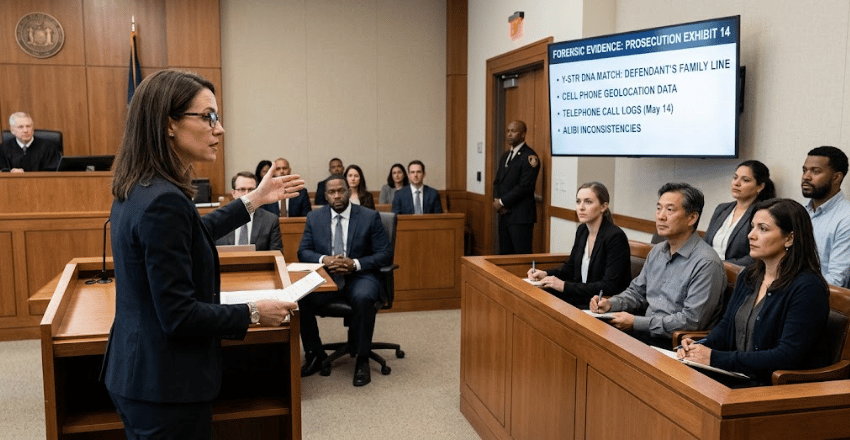
DNA became one of the most discussed parts of the prosecution. Investigators collected samples from the victim and compared certain Y-STR profiles with male members of the former husband’s family. The appellate court concluded that the resulting evidence supported the jury’s determination when considered with other circumstances.
The case was not based on DNA alone. The appellate court also discussed telephone activity, the defendant’s alibi, security-video issues, and communications involving the victim’s phone. Judges concluded that the combined circumstantial evidence permitted the jury to identify the defendant as the killer.
That distinction matters when reviewing any criminal prosecution. Circumstantial evidence can support a conviction even without an eyewitness who directly observed the crime. BlogsnBytes explains broader evidence challenges in its criminal defense strategy guide.
Why Was the DNA Evidence Disputed?
The defense emphasized limitations surrounding Y-STR testing and other male DNA found during the investigation. Defense filings argued that some samples could not identify one unique individual. They also pointed to DNA from unidentified males on some tested evidence.
That argument differed from the claim that no evidence connected the defendant to the scene. Prosecutors maintained that the relevant profiles, other evidence, motive, and opportunity supported their theory. The appellate court ultimately agreed that the evidence was legally sufficient to sustain the verdict.
Forensic evidence often requires context rather than a simple “match” or “no match” label. Different testing methods have different discriminatory power and limitations. That complexity became especially important in later efforts to seek additional testing.
The 2013 Trial and Guilty Verdict
The murder trial began in Spokane County in May 2013. Prosecutors presented evidence concerning the death, forensic testing, communications, and circumstances surrounding the former couple. The defense challenged the investigation, arguing that authorities had focused on the wrong person.
Jurors returned guilty verdicts in June 2013. Reporting from the time states that he was convicted of aggravated first-degree murder and sexually violating human remains. A judge later imposed life imprisonment without the possibility of parole.
The verdict did not end disputes surrounding the investigation. Family members on different sides of the case expressed sharply different views about the outcome. Those disagreements later fueled continued public interest in the case.
What Happened During the Appeal?
The defendant appealed, arguing that the trial court wrongly restricted evidence about possible alternative suspects. He also challenged whether sufficient evidence supported the convictions. Washington’s Court of Appeals rejected those arguments in its June 25, 2015 decision.
The appellate judges found the proposed alternative-suspect evidence too speculative under Washington law. They also concluded that the combined circumstantial evidence could support the jury’s findings. The judgment therefore remained in place after the direct appeal.
Appeals differ substantially from holding an entirely new trial. Appellate courts usually review claimed legal errors under specific standards. Readers interested in court procedure can also review BlogsnBytes’ pro se court guide.
Why Did DNA Testing Return to the Case in 2021?
A major later development occurred in June 2021. A Spokane County Superior Court judge granted a request to test additional evidence collected during the investigation. Counsel connected with the Washington Innocence Project filed the request.
The defense argued that several items had received limited testing or had not undergone newer forms of DNA analysis. Prosecutors responded that identifying another person’s DNA would not automatically establish innocence. The judge nevertheless authorized testing, creating another potential avenue for examining the forensic record.
That order should not be confused with a decision overturning the verdict. Permission to conduct testing allows evidence to receive additional scientific examination. Further legal action would still be required before test results could change an existing conviction.
Where Does the Case Stand Now?
As of October 2026, reliable sources reviewed for this article continue to describe the 2013 murder conviction as the controlling judgment. A recent 2026 legal overview likewise treats the conviction and appellate decision as remaining in effect. No reliable published source establishes that a court later vacated the judgment.
That wording matters because online discussions sometimes treat post-conviction testing as proof of exoneration. Testing authorization and exoneration are separate legal events. Any future change should be confirmed through a court order or another authoritative public record.
This also explains why older and newer articles can appear inconsistent. A 2021 report may accurately describe ongoing testing without establishing its eventual legal effect. Readers should distinguish motions, testing orders, appeals, and final judgments when following criminal cases.
Why the Case Still Draws Attention
The case combines several issues that often draw sustained true-crime interest. These include disputed forensic evidence, digital communications, a complicated family history, and later post-conviction litigation. National crime programs have also revisited the story years after the original trial.
Its lasting interest also reflects disagreement surrounding the verdict. The court system affirmed the conviction, while some relatives continued publicly supporting the convicted former husband. Those differing positions make precise sourcing especially important when discussing the case.
The safest approach is to separate established legal outcomes from allegations, defense arguments, and family opinions. Court judgments establish what the justice system decided. They do not erase disputes raised in later proceedings.
Frequently Asked Questions About Clay Starbuck
Who is Clay Starbuck?
He is the former husband of Chanin Starbuck, whose 2011 death led to a major Spokane County murder investigation. Jurors convicted him of aggravated first-degree murder in 2013. Washington’s Court of Appeals later affirmed the convictions.
What happened to Chanin?
Authorities found Chanin dead inside her Deer Park, Washington, home on December 3, 2011. Medical evidence established strangulation as the cause of death. Investigators concluded that the scene had also been altered after her death.
What sentence was imposed?
The trial court imposed life imprisonment without the possibility of parole after the 2013 convictions. Contemporary reporting confirms the sentence followed the aggravated first-degree murder verdict. The appellate court later left the judgment intact.
Was his conviction overturned?
No reliable source reviewed for this article shows that the conviction was overturned. The Washington Court of Appeals affirmed it in 2015. A later order permitted DNA testing but did not itself invalidate the verdict.
What did the 2021 DNA order mean?
The order permitted further scientific testing of evidence collected during the investigation. Defense attorneys argued newer testing could provide information unavailable during the original proceedings. The authorization alone did not establish innocence or change the sentence.
The Key Point to Remember
This case is best understood by separating the trial verdict from later challenges. A jury convicted the former husband in 2013, and an appellate court upheld that outcome in 2015. The 2021 DNA-testing order represented further review, not an automatic reversal.
Readers following future developments should rely on court records and established reporting rather than social-media claims. New testing matters only when its results are known and legally evaluated. For related legal context, BlogsnBytes’ homicide and criminal-defense resources provide useful background.